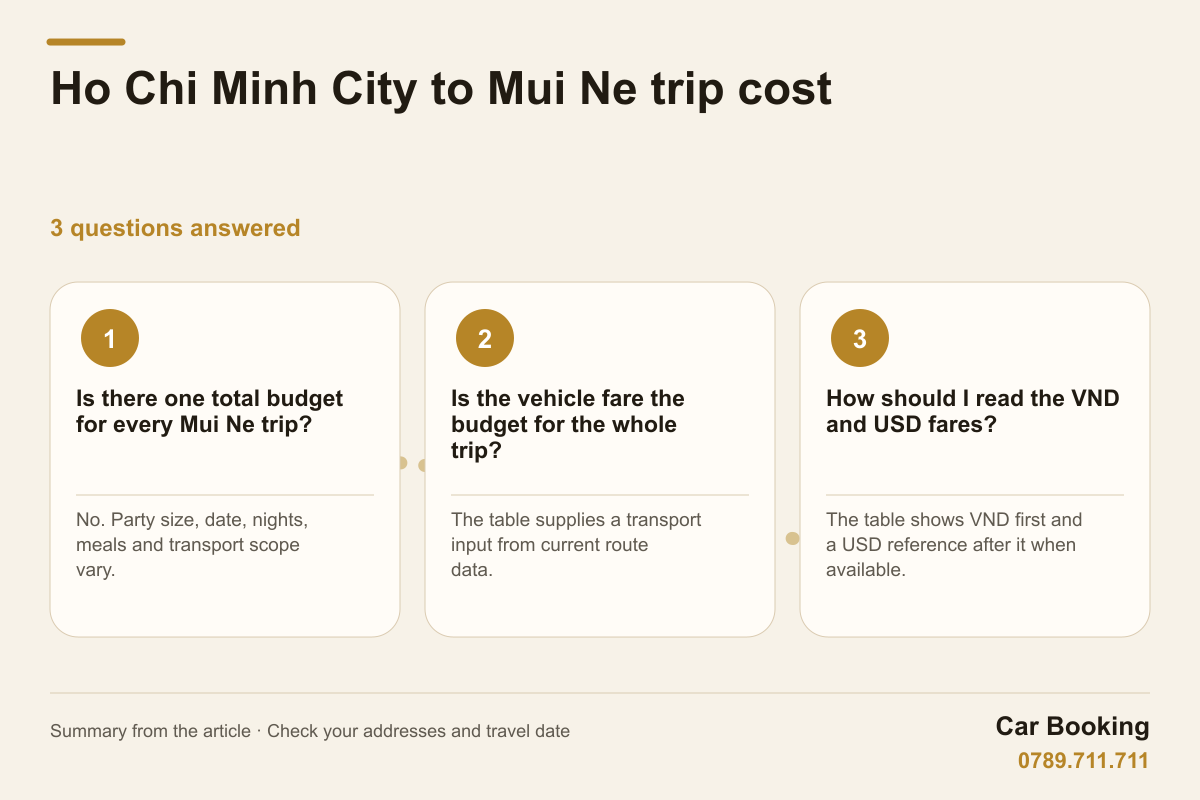
A Mui Ne trip budget needs four lines: the car journey, accommodation, meals and activities.
Start with the actual coastal address, because a Ham Tien resort, a stay near the fishing village and a property toward Hon Rom can change the transfer and any later local drives. Do not treat the intercity car fare as the cost of the whole holiday.
For the road portion, choose a vehicle that fits the group and check the live route information at the Ho Chi Minh City–Mui Ne route.
Then add only the meals and activities your party genuinely plans to buy.
What belongs in a Mui Ne trip budget?
Keep the outward and return road travel together in one section of your budget. Put the room and any resort charges in another. Meals form their own line; check whether breakfast is included before adding it again. Activities such as a dunes outing need a separate line for the activity itself and, if required, transport from the hotel.
This separation makes changes easy. If rain cancels an outdoor plan, you can change that activity line without confusing it with the price of the car from Ho Chi Minh City.
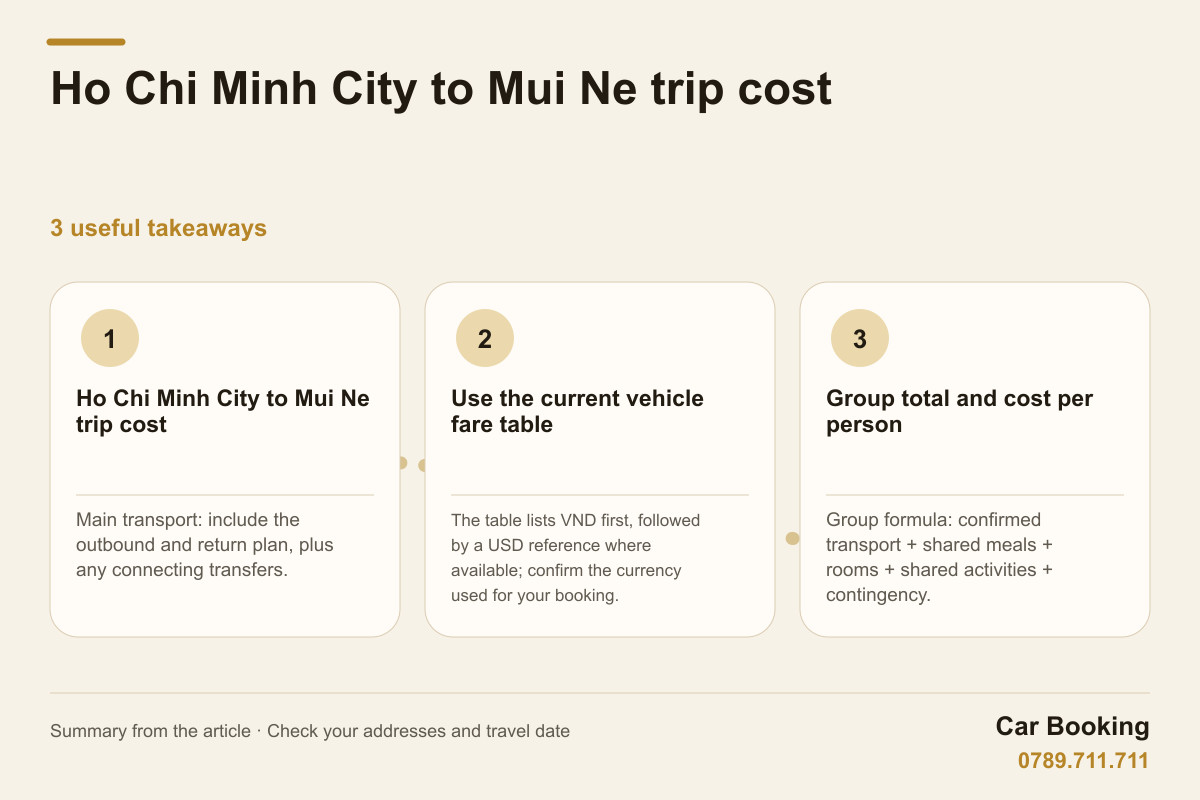
Use the current car table for the road line
Route fare estimates
Ho Chi Minh City → Mui Ne · / vehicle · one-way trip
| Our vehicles | Fares | Book a car |
|---|---|---|
| 4-seat car | 1.400.000 ₫ (54 USD) | Book a car |
| 7-seat car | 1.600.000 ₫ (62 USD) | Book a car |
| Limousine | 3.000.000 ₫ (115 USD) | Book a car |
| Kia Carnival | 2.200.000 ₫ (84 USD) | Book a car |
Reference fare; CARBOOKING confirms the final price from the actual itinerary. VND and USD are listed separately, not converted. Where a hotline is shown, call for a quote.
Use the row for a car that holds the people and bags. If a row asks you to call, request a quote for your travel date and addresses; do not estimate it from another vehicle. comparing fares by vehicle class explains how to compare the classes on the same journey.
Ask whether your quote covers tolls, parking, waiting and extra drop-offs. Record the answer next to the road line rather than hiding possible extras in a vague “miscellaneous” total.
How do you calculate a group share?
First find the total cost of the car service the group has agreed to. Then decide who is sharing it. Dividing by the number of travellers gives an average share, not a per-seat price sold by the car company. If someone joins only on the return or pays separately for a child, agree on the split before the trip.
Do the same separately for rooms and shared meals if the group wants one combined budget. This makes it obvious which costs are genuinely shared and which belong to individual travellers.
One-way transfer, return, or a car kept nearby?
A one-way transfer ends at the agreed resort entrance. A return transfer adds another date, pickup point and time. Keeping a car available for dinners, the fishing village or a dunes visit adds local journeys and possibly waiting. Put the option you actually want in the road line of your budget.
If you are staying close to the beach and expect to spend most of the time there, an all-day car may be unnecessary. a two-day, one-night Mui Ne itinerary gives a two-day outline that can help you decide whether local road transport is needed at all.
Keep a reserve without inventing a car price
Allow your group a modest reserve for a changed meal plan, another activity or a later return. Do not add that reserve to the published vehicle fare and call the result a Car Booking quote. If the requested route or hours change, ask for a revised vehicle amount and update only that line.
This distinction matters when friends compare two holidays. One may include breakfast and spend the day at the resort; another may use a car to explore farther along the coast. A single total without its parts hides the real difference.
Three ways the budget changes
A couple planning a quiet resort stay
Budget for the transfer, room, meals not included with the stay, and any small local spending. If they do not need the car after drop-off, there is no reason to price a full day of local service into the plan.
A family with beach gear
Choose the vehicle after counting cases, a pushchair and other large items. Add meals for the family and any activity they will actually do. A cheaper car that cannot hold the belongings is not a sound saving.
Friends visiting the dunes
Separate the road transfer, local transport to the dunes and whatever activity the group chooses there. Do not assume the transfer fare pays for equipment or a local service at the destination.
A budget you can revise quickly
- Car: vehicle, dates, pickup and coastal drop-off, stops and return.
- Stay: room, included breakfast and any known property charges.
- Meals: what the group expects to eat outside the accommodation.
- Activities: optional visits and the local transport each needs.
- Reserve: a separate amount for choices that may change.
When the road plan is settled, use details for the Ho Chi Minh City–Mui Ne journey to request the car for that exact journey.
Frequently asked questions
Is the car fare the full Mui Ne trip cost?
No. Accommodation, meals and activities are separate unless a specific booking explicitly includes them.
Should we divide the car table amount by each passenger?
You can use a confirmed vehicle quote to calculate an average group share. The table does not sell individual seats; agree on how your group will split its costs.
Should we budget for a driver on every day?
Only if the group needs the vehicle. Decide whether you want direct transfers, local use, or both, then ask for the matching quote.