There is no single expressway from every part of Ho Chi Minh City to every address in Vung Tau.
The journey can use the Ho Chi Minh City–Long Thanh–Dau Giay expressway, then continue by National Highway 51 or, where the vehicle and entrances are permitted, the Bien Hoa–Vung Tau expressway. Local roads are still needed at both ends.
For the complete private-car journey, see the Ho Chi Minh City–Vung Tau route.
Here is how the major roads connect and what to check before choosing an expressway approach.
Which expressways are on the Ho Chi Minh City–Vung Tau journey?
The Ho Chi Minh City–Long Thanh–Dau Giay expressway carries traffic east from the city toward Long Thanh. From there, the long-established route toward Vung Tau continues by National Highway 51, which is not an expressway. The Bien Hoa–Vung Tau expressway adds a newer connection from the Long Thanh area toward the coast.
The names describe different segments, not interchangeable names for one continuous road. Your usable route depends on the entrance near your pickup, the exit for your destination and the rules for the vehicle you have booked.
How the segments fit together
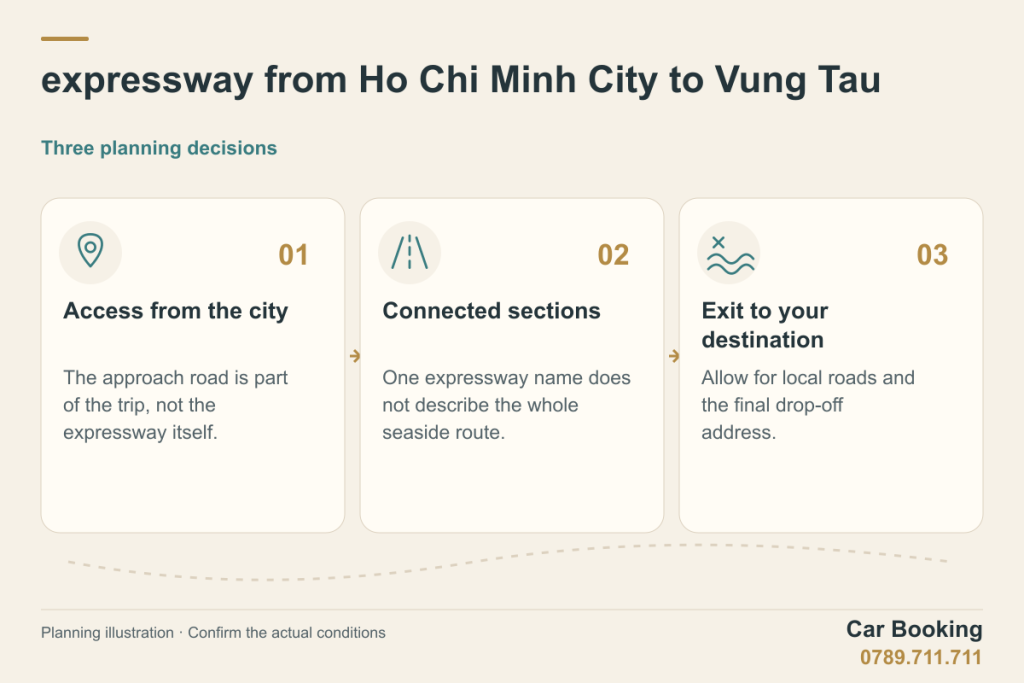
Think of the route in three parts: city streets to the expressway entrance; the main road or roads through Long Thanh and toward Vung Tau; and the final approach to your hotel, beach or home. An expressway may make the middle part easier, but it does not eliminate the first and last parts.
When checking a map, look at the proposed interchange, not just the road name. A route may show the Bien Hoa–Vung Tau mainline while the particular ramp you need has different access conditions. Follow the signed route at the time of travel.
What changed in 2026?
The Bien Hoa–Vung Tau expressway and its connection with the Ho Chi Minh City–Long Thanh–Dau Giay route began operating in 2026. That gives eligible drivers another road option beyond the traditional National Highway 51 approach. Its early operation included temporary vehicle and access restrictions, so an opening announcement alone is not proof that every ramp and vehicle class is available for a future trip.
Check current traffic organization close to departure. A driver of a larger passenger vehicle, in particular, should not assume that permissions for a smaller car apply to that vehicle.
Check vehicle and interchange access
The question is not only “Is the expressway open?” It is “Can this vehicle enter at the intended interchange, travel the planned section and leave at the needed exit today?” Temporary signs, lane control and maintenance can change the answer.
If an entrance is unavailable, use a lawful alternative such as the signed National Highway 51 approach. Do not attempt to turn around on an expressway or follow a map against road signs. For a booked transfer, confirm the vehicle class and let the driver choose a permitted route.
Why expressway travel time still varies
A clear mainline does not guarantee a fast door-to-door trip. Queues at the city exit, an interchange, a toll point or the final Vung Tau streets can dominate the total. Departure time, weather and a weekend return can also change conditions.
Use a live route estimate for your actual addresses and departure time. Treat any published duration as a rough guide, not a promise of arrival by a fixed hour.
Rest stops and electric-vehicle planning
Plan a break around the needs of your passengers, then use a lawful stop with appropriate facilities. Do not assume you can pull over on an expressway shoulder for a routine break. If anyone needs a toilet stop or extra time to board, tell the driver in advance.
For an electric vehicle, check the actual car’s charge and the charging options along the chosen route and at the destination. There is no universal requirement to charge on this journey; it depends on the vehicle, starting charge and onward plans.
Putting the network into a trip plan
Using the long-established approach
From a suitable city entrance, take the Ho Chi Minh City–Long Thanh–Dau Giay expressway and continue toward Vung Tau by National Highway 51. This remains an option when a newer connection is not suitable for the vehicle or the intended entrance.
Considering the Bien Hoa–Vung Tau expressway
Check the proposed connection at Long Thanh, the relevant exit, current signs and vehicle permission. Compare the complete arrival time with the National Highway 51 option; the newer road is not automatically quicker for every address.
Travelling in a larger passenger vehicle
Confirm access rules for the exact vehicle, not just the number of people in your group. Temporary restrictions on the newer road have applied during its initial operation. If the planned vehicle cannot use it, ask the driver to use an appropriate permitted road.
Missing an exit or finding a closure
Continue to the next lawful opportunity to adjust the route. A map may recalculate; that does not authorize reversing, stopping in a live lane or using an unsigned connection. Allow extra time if a particular arrival is important.
Before relying on an expressway route
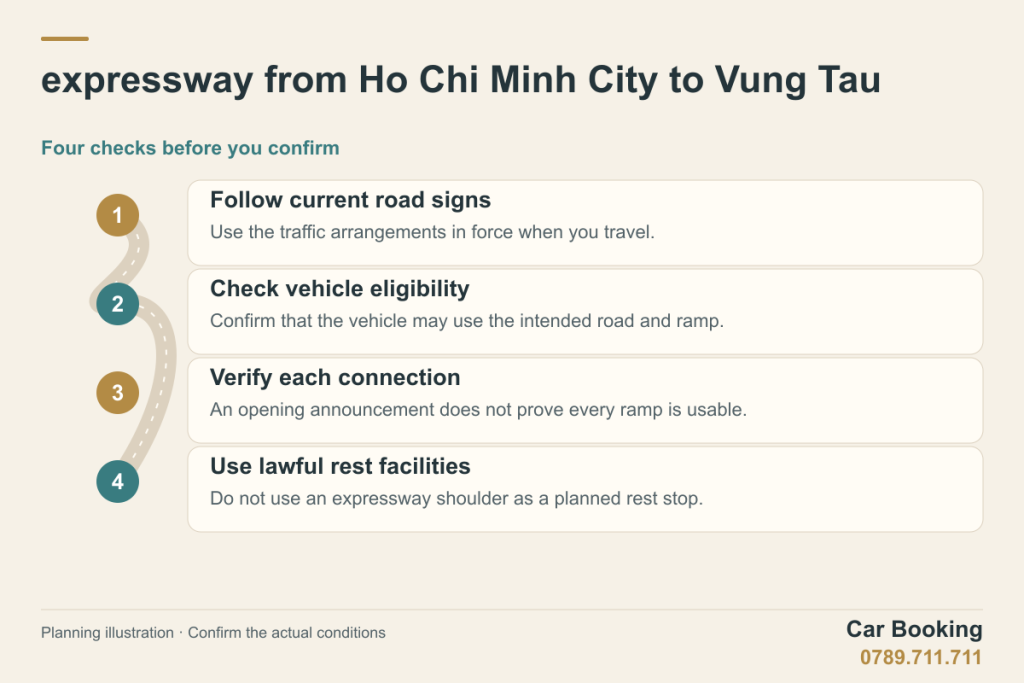
- Identify the entrance and exit that serve your exact addresses.
- Check current access for the vehicle you will actually use.
- Compare the entire journey with the National Highway 51 option.
- Plan any passenger rest or charging needs before departure.
- Follow signs and traffic control even if a map suggests otherwise.
If your main question is which route will be quicker on your travel day, use choosing the road for your departure. For a comfortable planned break, see choosing a lawful stop along the journey.
Frequently asked questions
Does an expressway cover the whole city-to-hotel trip?
No. You still need local roads to reach the entrance and the final destination in Vung Tau.
Is National Highway 51 an expressway?
No. It is the national highway used on the long-established onward approach after the eastern expressway.
Is every Bien Hoa–Vung Tau ramp open to every vehicle?
Do not assume that. Check current signs and official traffic guidance for the section, interchange and vehicle class you plan to use.
Does the newer expressway guarantee a shorter trip?
No. Its benefit depends on the entrance, exit, traffic and final address. Compare live door-to-door estimates shortly before leaving.
Can an electric vehicle make the journey without charging?
That depends on its battery, starting charge and further travel. Check the specific vehicle and route instead of assuming a stop is either required or unnecessary.
When the road choice is clear, confirm details for the Ho Chi Minh City–Vung Tau journey for your pickup, destination and vehicle.