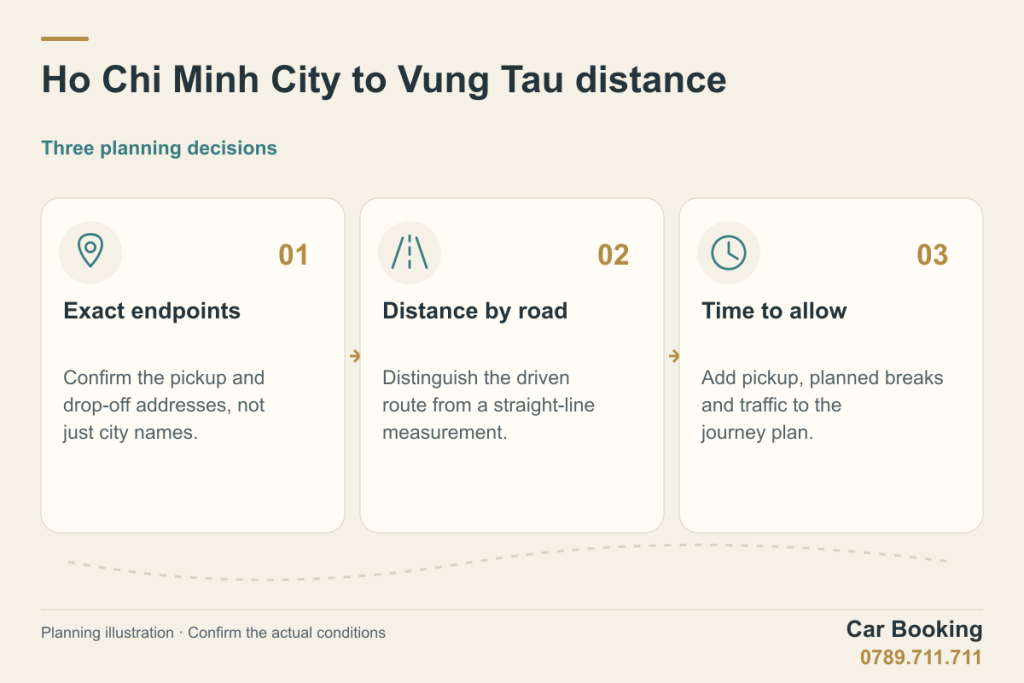
Ho Chi Minh City to Vung Tau is usually about 100–125 km by road, depending on where you are collected and dropped off. Measure your actual addresses before relying on a single distance.
For your own trip, measure from the place the car can actually collect you to the place it can stop in Vung Tau. Add any pickups or detours.
If you are planning an arrival time, allow about 2–3 hours on the road as a starting range, then account for traffic and stops.
Once your addresses are settled, compare them with the Ho Chi Minh City–Vung Tau route.
How far is Vung Tau from your starting address?
Use about 100–125 km as an early road-distance estimate, then check the actual pickup and destination. An airport pickup, a central hotel and a home on the city’s edge start in different places. A Back Beach hotel and an address near Front Beach also need different final approaches.
If you have not chosen accommodation yet, use a broad range to decide whether the day is feasible. Once you know the property, replace the beach name with its entrance and measure again. Keep the exact addresses beside the result so you know what the number means later.
Five checks before you rely on a distance figure
- Pickup: use the street address and boarding gate, especially at a hotel, apartment complex or airport.
- Drop-off: use the hotel entrance or another place where your vehicle can stop, not just “Vung Tau”.
- Stops: add other pickups, meals or sightseeing in the order you plan to visit them.
- Road: check the drivable route for your vehicle and travel date, rather than using a straight-line measurement.
- Direction: measure the return separately if you will leave from a different place or stop on the way home.
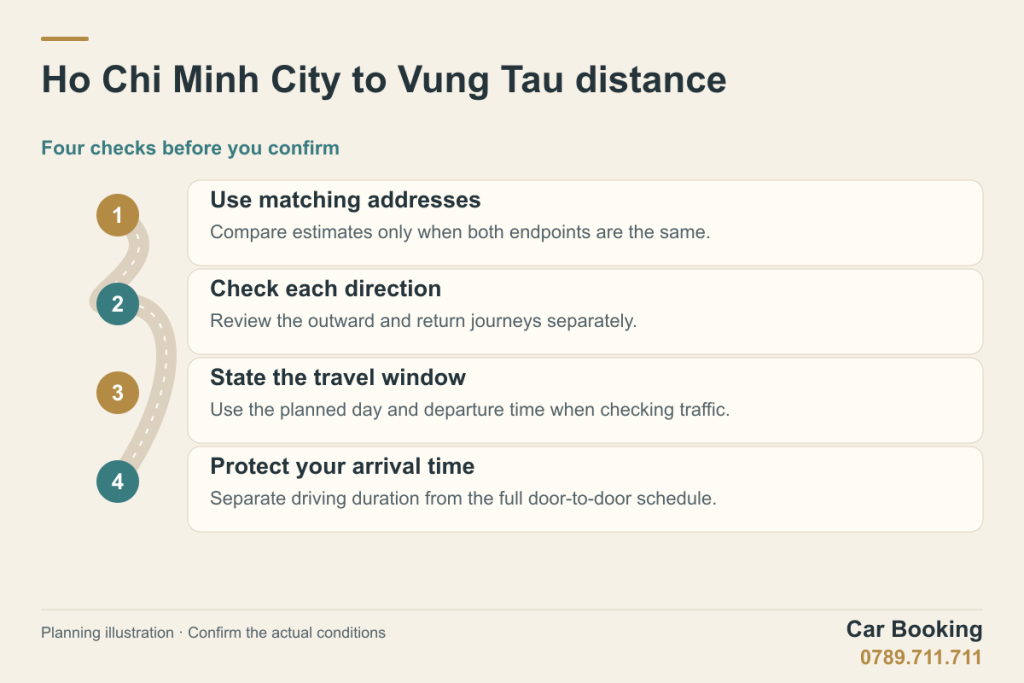
These details are easy to send with a booking enquiry. They also let you compare two estimates fairly: each must describe the same journey.
Why do two maps show different kilometres?
First check the endpoints. A map pin on a beach can differ from the road entrance to your hotel. A second pickup across the city adds another leg even though both enquiries are described as “Ho Chi Minh City to Vung Tau”.
Next check the kind of distance shown. A straight line is useful for orientation, but a car follows roads, junctions and permitted access. A shorter road on a map may also involve a ferry or a connection that does not suit the journey. Keep the route choice with the kilometre figure instead of averaging two unlike results.
How much time should the drive take?
Allow roughly 2–3 hours on the road for early planning, then adjust for the pickup, destination and traffic. If you have a hotel check-in or lunch reservation, share that arrival time when arranging the car so the departure can be planned around it.
A flight landing at Tan Son Nhat is not the start of the drive. Passengers still need to leave the aircraft, collect bags and meet the car. For an airport pickup, plan those steps separately, then count road time from the agreed meeting point. Meals, rest breaks and extra pickups add time even when they add few kilometres.
If you have a check-in, event or evening flight, share the time you must arrive. It is more useful than asking for the shortest possible travel time.
Which road should the estimate use?
A route towards Vung Tau may use the Ho Chi Minh City–Long Thanh–Dau Giay expressway and National Highway 51, or another available connection. The choice depends on the departure point, traffic and roads open to the vehicle on that day. A map suggestion alone is not confirmation that every ramp or turn is usable.
Compare alternatives between the same two addresses. Look at road distance and expected time together; fewer kilometres do not always mean an earlier arrival. If you are considering the Cat Lai ferry, include its waiting and crossing time as well as the road on either side.
Three trips that need different measurements
From Tan Son Nhat to a Back Beach hotel
Use the airport meeting point as the origin and the hotel’s vehicle entrance as the destination. Tell the driver when passengers are likely to be ready after baggage collection. Keep that airport time separate from the road estimate.
From a central hotel to Front Beach, with a second pickup
Enter both Ho Chi Minh City pickups in order. If the second traveler meets the group at a main-road stop, check that they can reach it with their bags. Measure the actual pickup plan, not the direct hotel-to-beach journey.
Back from dinner at a different address
If you arrive near Back Beach but leave after dinner near Front Beach, the return starts from another point. Record that pickup and the final Ho Chi Minh City address. Adding the two separately measured legs gives a more useful round-trip total than doubling the outward distance.
A short distance check before booking
Send both entrances, any extra pickups, the date and time, the vehicle size and the place where you need to be by a fixed hour. Ask which road estimate the booking uses. If a stop changes later, update the plan so the distance and timing still describe the real trip.
Distance is only one part of planning. Use planning the overall trip budget to consider the rest of the day’s costs, and choosing a road for your departure time when comparing roads for your departure time.
Questions travelers often ask
Can I use one distance for every trip to Vung Tau?
No. An airport, a central hotel and a home address are different starting points. Measure from your actual pickup to the place the car can drop you off, including any stops.
Is 100–125 km a guaranteed range?
No. It is a planning range while the addresses are unsettled. Measure the trip again once you know both entrances.
Can I use the same figure for the return?
Only for a very rough early estimate when the endpoints and stops match. A different return pickup or a detour calls for a separate measurement.
Does the shortest road always take the least time?
No. City traffic, junctions, ferry queues and current road conditions can outweigh a small difference in kilometres.
What should I send for a useful route check?
Send the exact pickup and drop-off, stops in order, departure date and time, passenger and luggage needs, and any arrival deadline. You can then use details for the Ho Chi Minh City–Vung Tau journey to discuss a trip measured around the places you will actually use.